
Choosing a stairlift: what to consider
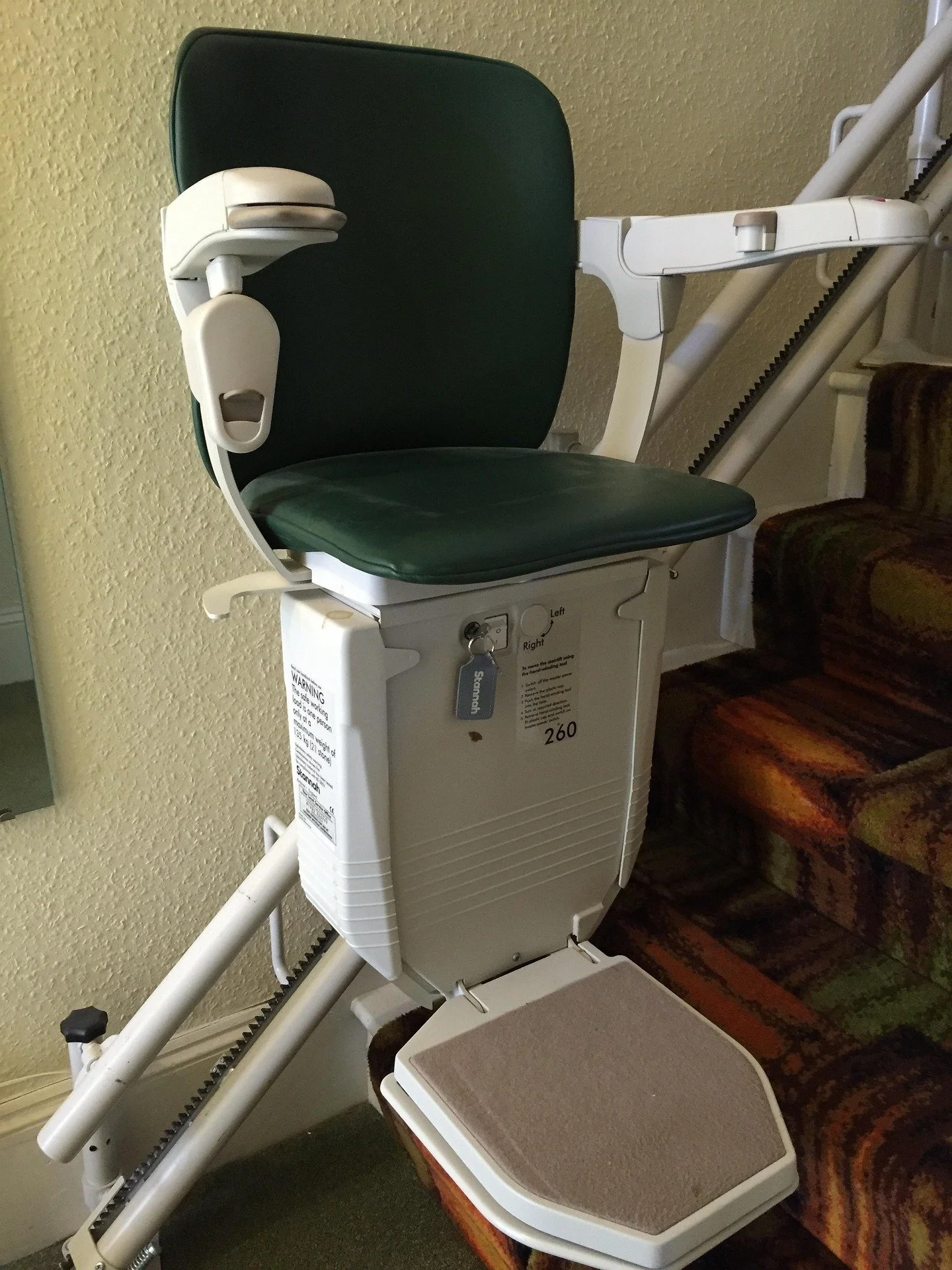
When the stairs become difficult, additional rails or other smaller changes may help. Where they are no longer enough, the main options are often to live downstairs, move somewhere on one level, or install a lift.
Living downstairs usually founders on the bathroom, and solving that often costs more than a lift would have done. Moving costs money, and it can cost something less obvious as well: the neighbours who notice when the curtains stay shut, the years of memories and the friends who drop in. For most households, a lift turns out to be the practical answer.
Is a stairlift the right kind of lift?
A stairlift suits someone who can walk but finds stairs difficult. They need to be able to sit safely while it is moving, and to get on and off at both ends either independently or with a little help.
If someone already needs a wheelchair to get around indoors and cannot transfer safely on and off a stairlift, a stairlift is probably the wrong question. A through-floor lift, which carries a person and their wheelchair between floors, is likely to be the one worth asking.
Think about where this is going, not just where it is now
If a condition is likely to progress, the lift that works today may not work in two years. A stairlift that suits someone while they can still transfer independently becomes unusable when they cannot, and by then it has been paid for and installed.
A through-floor lift costs more at the outset and keeps the wheelchair option open. Whether that trade is worth making depends on the situation, but it is a decision worth taking deliberately rather than by default.
What to check before deciding
Whether the person can bend their knees enough to travel seated. This rules a stairlift out more often than people expect.
Who needs to operate it. Controls can be fitted for the user, for a carer, or both, and it is far easier to have that done at installation than to add it later.
The transfers at each end. A swivel seat and lift-up armrests make getting on and off easier, and the controls for the seat and footrest need to be ones the person can actually manage.
The staircase and what is around it. Doors and thresholds at the top or bottom, bulkheads, banister rails and radiators all affect what can be fitted and how much room is left to get on and off.
Everyone else who uses the stairs. Children, pets and visitors all have to get past whatever is installed.
Walking aids. A stick can travel on the lift. A frame cannot, so you will need one at the bottom and another at the top, which is an extra cost people rarely budget for.
Do not fit a straight lift to a curved staircase
It is a common way to save money: fit a straight lift up the straight section and manage the last few steps on foot. It works until it does not. If the condition that made the stairs difficult gets worse, those few steps become the whole problem, and the lift that was bought to solve it no longer does.
Wherever possible the lift should cover the entire staircase, whether that means a curved lift or a straight one with a platform at the turn.
Paying for it
A disabled facilities grant can cover a stairlift, and an Occupational Therapy assessment is normally part of applying for one. Your local council can explain how to apply.
Getting an assessment
A stairlift company will tell you which of their lifts fits your stairs. An Occupational Therapist starts from the person and the whole house, and will sometimes tell you that a lift is not the answer at all. Our housing and equipment assessments cover the stairs alongside everything else that is becoming difficult.
Getting in and out of bed and out of a chair often become harder at the same time as the stairs, so it can be worth looking at a profiling bed and a riser recliner chair in the same conversation.
Get in touch and tell us what is becoming difficult, and we will explain what an assessment would involve and what it costs.